EPI and PPI in Weaving: Read a Sample Record
- What do EPI and PPI mean in weaving?
- Which direction do you count?
- Is EPI the same thing as sett, DPI, or WPI?
- How do you calculate density from a measured span?
- What if the count changes across the cloth?
- Why must the record name the measurement stage?
- Should EPI and PPI always match?
- What belongs on a useful sample record?
- Sources
What do EPI and PPI mean in weaving?
EPI means ends per inch: the number of warp threads across an inch of woven cloth. PPI means picks per inch: the number of weft passes along an inch. Record both separately, with the measurement location and whether the cloth is on the loom or finished. They describe spacing, not fibre identity or quality. Practise on your own sound samples; fragile, valuable, or culturally sensitive textiles need appropriate specialist guidance.
The abbreviations become more useful when attached to a clear record. “Twelve” is incomplete; “12 EPI, measured across the centre of the dry finished sample” tells someone what you counted and where.
Which direction do you count?
Warp is the yarn system prepared on the loom; weft travels across it. One warp thread is an end. A weft pass is a pick. Gist Yarn's weaving definitions distinguish ends per inch from picks per inch and describe sett as the distribution of warp ends.
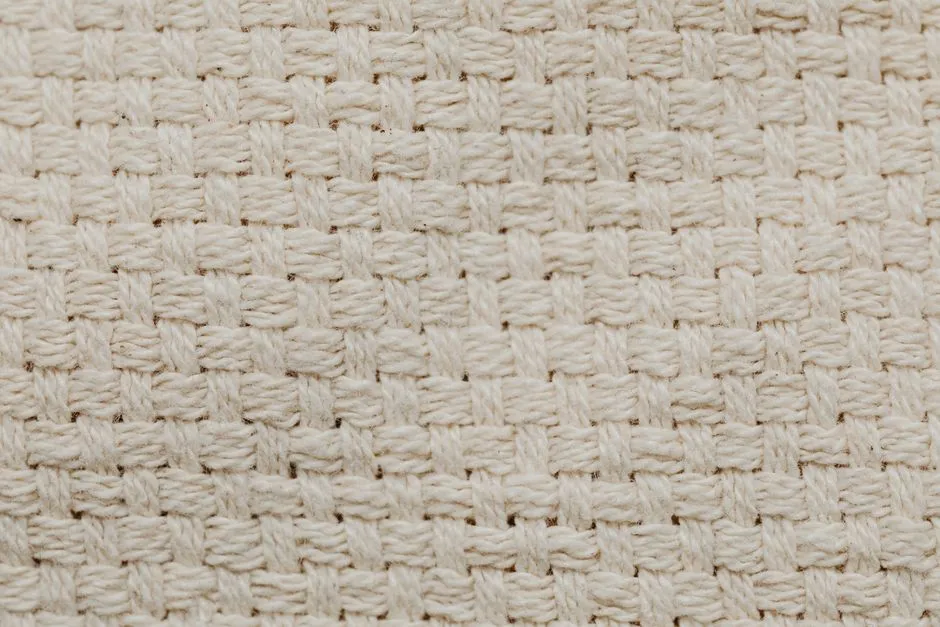
For the straightforward woven sample used here, count across the warp threads to obtain EPI. Count across the weft rows to obtain PPI. The ruler crosses the yarn system being counted; it does not follow one thread along its length.
Do not let a stripe determine the direction. A colour effect may belong to either yarn system. Use the sample's weaving record to establish warp and weft first. If the direction is unknown, record that uncertainty rather than assigning the more visible yarns to the warp.
This guide concerns readable, ordinary single-layer practice cloth. Multilayer construction, supplementary yarns, pile, or hidden crossings can require a more specialized description. A simple count should not silently stand in for a full structural analysis.
Is EPI the same thing as sett, DPI, or WPI?
These terms describe related but different information.
| Term | What it records | What not to assume |
|---|---|---|
| EPI | Warp ends per inch | That a finished-cloth count equals the original loom setting |
| PPI | Weft picks per inch | That it must equal EPI |
| Sett | Warp spacing, commonly expressed as EPI | That the abbreviation specifies every construction detail |
| DPI | Dents, or spaces, per inch in a reed | That every space necessarily contains one warp end |
| WPI | Wraps of yarn per inch on a measuring support | That this is already a measured cloth density |
Gist's glossary explains dents, reeds, and wraps per inch. WPI describes yarn arranged around a support, not interlaced cloth. Its use in estimating a starting sett does not eliminate the need to sample.
Keep the reed specification and the threading arrangement together. As a purely arithmetic illustration for a multi-shaft loom reed, 10 dents per inch containing 2 ends in every dent would distribute 20 ends per inch in the reed. That calculation does not specify a suitable yarn, a safe threading procedure, or the eventual finished width.
Do not transfer that arrangement automatically to a rigid heddle, whose slots and holes also participate in forming the weaving sheds. Follow the particular loom's instructions and a qualified weaving teacher's guidance for setup.
How do you calculate density from a measured span?
For a count made across a known span:
- EPI = number of warp ends counted ÷ span in inches.
- PPI = number of weft picks counted ÷ span in inches.
Here is an original fictional counting exercise, not a textile we have woven or tested. Assume that the yarns are fully visible, the cloth lies without deliberate stretching, and each counted yarn belongs to one known system.
Across a 2-inch width, the observer counts 24 warp ends. The result is 24 ÷ 2 = 12 EPI. Along a separate 2-inch length, the observer counts 28 weft picks. The result is 28 ÷ 2 = 14 PPI.
The record should retain “24 ends over 2 inches” and “28 picks over 2 inches,” not just the results. Those raw observations let another person check the arithmetic and understand the measuring span.
For your own sound practice sample, use good light and a ruler without pulling yarns apart. Adopt a consistent boundary convention: for example, count yarn centres at the starting boundary but not at the ending boundary. This is our suggested notebook method, not a laboratory testing standard. If the boundary or yarn path cannot be seen reliably, record an approximate count or leave it unresolved.
What if the count changes across the cloth?
A single window describes that window. It need not describe the entire sample.
Continue the fictional example with three separate, non-overlapping 2-inch windows across a sufficiently wide sample. The counts are 24, 26, and 25 warp ends. Their local densities are 12, 13, and 12.5 EPI. Together, the windows contain 75 counted ends across 6 measured inches, so the combined density is 75 ÷ 6 = 12.5 EPI.
Reporting only “12.5 EPI” would hide the variation. A better notebook entry is “three 2-inch windows: 24/26/25 ends; local EPI 12/13/12.5; combined 12.5 EPI.”
Do not invent a universal tolerance from this exercise. Whether that variation matters depends on the planned cloth, the measurement method, and the teacher's or pattern's stated requirements. Nor does the count identify the cause. Uneven spacing, measurement uncertainty, or a deliberately varied construction need different explanations.
Keep edge observations separate when comparing them with the centre. Describe the location rather than dismissing an inconvenient reading.
Why must the record name the measurement stage?
A setting in the reed, cloth under loom tension, cloth released from the loom, and cloth after its specified finishing process are different states.
In Jane Patrick's sett investigation for Schacht, yarn, intended use, and finishing all matter to the choice of sett. Her actual sample observations belong to the yarns and treatment she describes; they are not universal instructions for every textile.
Our separate mathematical model shows why the stage matters. Suppose a defined band contains the same 50 warp ends throughout:
- At a recorded width of 5 inches, its average density is 50 ÷ 5 = 10 EPI.
- At a later recorded width of 4 inches, its average density is 50 ÷ 4 = 12.5 EPI.
No ends were added in this model. The same number occupies less width. The dimensions are hypothetical, not a predicted shrinkage rate or evidence that a particular finishing method is appropriate.
For a new sample you have permission to work on, follow the yarn and project care instructions when finishing it. Do not apply hot water, steam, pressing, detergents, or other treatments to an inherited or unidentified object merely to obtain another measurement.
Should EPI and PPI always match?
No. Equal counts can be relevant to a balanced construction, but they are not a universal target for weaving.
The Textile Museum's terminology describes balanced plain weave as using warp and weft yarns of the same size with equal spacing. That definition includes yarn size and structure, not just two matching numbers.
A sample recorded as 12 EPI and 12 PPI therefore still needs its yarn and weave description. Different yarn sizes or a different structure can change the visible result. A sample at 12 EPI and 14 PPI is not automatically defective.
The companion comparison of plain weave, twill, and satin explains what crossing patterns contribute. Density and structure answer different questions, and neither establishes a textile's maker, provenance, or cultural meaning.
What belongs on a useful sample record?
Amanda Rataj's sampling guidance for Gist includes yarn information, sett and reeding, dimensions before and after washing, and treatment notes. Our expanded worksheet separates planned values from observations:
- Sample identifier and date.
- Warp and weft yarn details, kept separate; mark unknown information.
- Weave structure and reference to the pattern or teacher's instructions.
- Planned sett, reed specification, and threading arrangement.
- Measurement stage and location.
- Raw counts, spans, units, and calculated EPI/PPI.
- Dimensions and the actual finishing process, if one was appropriately performed.
- Observations and questions for the next sample.
Write “planned 12 EPI” and “observed 13 EPI” in separate fields. Do not overwrite one with the other. That preserves the difference between intention and result.
Keep notes separate from collection textiles. The Smithsonian's handling guidance advises planning before touching antique textiles and consulting a textile conservator instead of attempting improvised treatment. Fragile, valuable, mould-affected, pest-affected, or culturally sensitive pieces require appropriate conservation advice and, where relevant, knowledgeable makers or community custodians.
For further study, use Weaving Basics for construction vocabulary and Textile Care for the limits of handling and treatment. A good sample record makes a measurement understandable without claiming more than it shows.
Sources
- Gist Yarn: EPI, PPI, WPI and sett, weaving glossary, and sampling records.
- Schacht: How to Choose the Right Sett, by Jane Patrick.
- The George Washington University Museum and The Textile Museum: Textile Terms.
- Smithsonian Museum Conservation Institute: Handling antique textiles and costumes.