Plain Weave vs Twill vs Satin: What Changes?
What is the difference between plain weave, twill, and satin?
Plain, twill, and satin are weave structures: patterns governing how warp and weft threads cross. Plain weave alternates over one and under one. Twill floats over multiple yarns and offsets successive rows, producing a diagonal. Satin spaces longer floats across the surface, creating a distinct face with fewer visible intersections. Fibre, yarn, density, finishing, and wear also shape the cloth, so structure alone does not predict every property.
Start with warp, weft, and interlacing
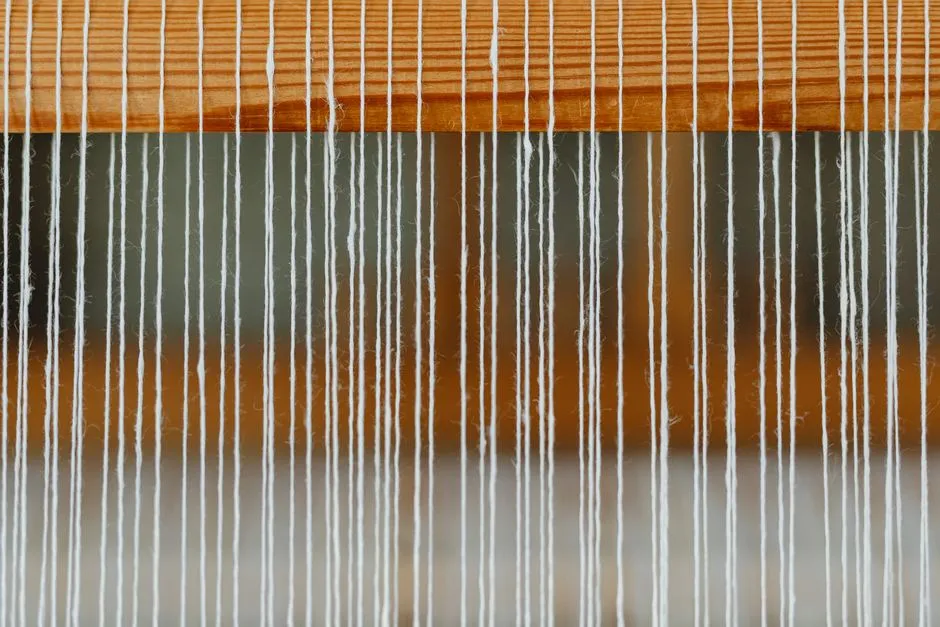
Warp is the yarn system held under tension on a loom and usually running lengthwise through the cloth. Weft travels across and interlaces with the warp. An interlacing is a point where one system passes over or under the other.
A float is a length of yarn that passes over more than one thread before interlacing again. Float length and placement help distinguish the three structures. To inspect a sample, use good light and modest magnification. Look at both faces and a clean edge if one is available; dense yarn, pile, finishing, paint, or printing can conceal the crossings.
How plain weave works
The Victoria and Albert Museum's textile glossary defines plain weave as a simple structure in which each weft passes alternately over and under each warp. On the following pass, the order reverses, locking the two yarn systems into a regular grid.
When warp and weft are similarly sized and spaced, both may remain visibly important. If one system is much more closely spaced, it can dominate the surface and conceal the other. That is why two plain-weave cloths can look and behave quite differently.
Plain weave is a structural description, not a fibre. Cotton, linen, wool, silk, and manufactured fibres can all appear in plain-woven cloth. Nor does the term identify a single use, region, period, or level of workmanship.
Why twill forms a diagonal
In a twill, a yarn passes over more than one opposing yarn before going under, and that sequence shifts in the next row. The stepped offset produces the characteristic diagonal line.
Direction, repeat, yarn colour, density, and finishing can make the diagonal bold, subtle, or hard to see. Reversing the direction can create chevrons or other effects, but a visible diagonal by itself is not enough for a confident identification. Examine the actual interlacing rather than relying only on the surface impression.
Twill has fewer interlacing points than a comparable plain structure, which can allow yarns more movement. That is a structural tendency, not a promise that every twill is softer, stronger, heavier, or more durable. Fibre, yarn twist, sett, finishing, and condition still matter.
What creates a satin face
Satin structure uses longer floats spaced so that adjacent interlacing points are less conspicuous. The surface can therefore appear smoother and more continuous than plain weave or many twills. In a warp-faced satin, warp floats dominate the face; related structures can be organised differently.
“Satin” is also used as a fabric name, which can create confusion. It does not mean silk. Silk is a fibre, while satin describes structure and, by extension, fabrics made with that structure. A satin can use other fibres, and a silk cloth can use a different weave.
Longer exposed floats can catch or abrade in some constructions, but it would be inaccurate to call every satin fragile. Yarn, float length, density, finishing, use, and present condition determine the practical risk.
Compare the three structures
| Structure | Basic crossing pattern | What to look for | What the name does not prove |
|---|---|---|---|
| Plain | Over one, under one, with the order reversed on the next pass | Frequent crossings and a grid-like organisation | Fibre, stiffness, strength, origin, or use |
| Twill | Floats across multiple yarns with successive rows offset | A diagonal created by stepped crossings | That every diagonal surface is twill or that every twill behaves alike |
| Satin | Longer floats distributed so intersections are less visible | A smoother dominant face with scattered crossings | Silk content, quality, durability, or ceremonial meaning |
Structure is not cultural meaning
Plain weave, twill, and satin are technical vocabulary used across many textile contexts. A structure cannot establish who made an object, what a motif means, whether it is ceremonial, or which community has authority to interpret it.
For a specific textile, preserve maker, community, collection, material, date, and technique information from reliable records. Do not turn one museum object into a universal account of a living tradition. When meaning or permitted use matters, seek information from the maker or an appropriate community source.
The companion guide on handling and storing textiles begins from the same limit: visual structure is useful evidence, but it does not supply a complete care history. More structural vocabulary appears in Weaving Basics.
Sources
- Victoria and Albert Museum, A–Z of Opus Anglicanum — accessed September 3, 2026; supports the plain-weave definition used here.
- George Washington University Textile Museum, Textile Terms — accessed September 3, 2026; supports the warp, weft, plain-weave, balanced, warp-faced, and weft-faced terminology.
- George Washington University Textile Museum, Structure — accessed September 3, 2026; supports the twill offset and diagonal, satin float structure, and comparative movement statements.